International Street-Food Context

Eating Traditions in Conversation

Street food is the world’s most democratic public architecture. Around a sidewalk cart or market stall, office clerks, night-shift drivers, students, and families stand shoulder to shoulder, eating from the same griddle and reaching for the same bowls of pickled onions and salsa. In 2010, UNESCO inscribed traditional Mexican cuisine onto the Representative List of the Intangible Cultural Heritage of Humanity, recognizing the continuous chain from indigenous farming to communal eating.

Yet Mexican street food has never existed in isolation. By examining both historical trade routes and parallel flatbread cultures across the Middle East, South Asia, East Asia, and the Americas, we see how portable street meals speak to one another across oceans.

01 / Migration & Adaptation

From Ottoman Vertical Spits to the Puebla Trompo

Few stories illustrate culinary cross-pollination more clearly than the migration of the vertical roasting spit. In 19th-century Bursa, in the Ottoman Empire, cooks stacked seasoned lamb vertically before a column of hot charcoal so melting fat basted the meat downward rather than dripping into flames and flaring up—a method known as döner kebap in Turkish and shawarma in Arabic.

Between the 1890s and 1930s, thousands of families migrated from Greater Syria and Mount Lebanon to Mexican ports such as Veracruz, settling heavily in Puebla and Mexico City. Opening small eateries, they adapted their vertical spits to local ingredients: swapping lamb for pork, seasoning it with cumin, garlic, thyme, and oregano, and wrapping shaved slices in thick wheat flatbread called pan árabe alongside smoky chipotle salsa. By the late 1950s and 1960s, Mexican taqueros replaced the herbal marinade with red guajillo-achiote adobo, crowned the cone with a peeled pineapple, and served the shavings on small nixtamalized corn tortillas—giving birth to the iconic taco al pastor (named "shepherd-style" in memory of its lamb origins).

02 / Parallel Flatbread Engineering

Global Cousins of the Handheld Street Wrap

Even where direct migration did not occur, urban street vendors across continents arrived at remarkably similar culinary geometry: a freshly griddled or baked starch disc, a high-heat protein or spiced legume center, and a sharp acidic pickle or herb relish.

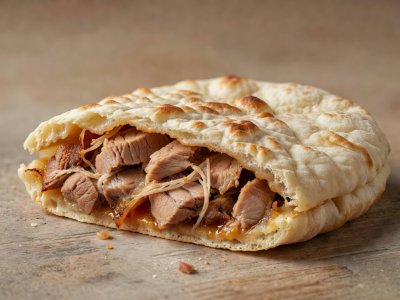
Soft-lit 3D render illustration of a crisp baked Shaanxi baijimo flatbread stuffed with braised pork Shaanxi & Sichuan, China

Roujiamo & Jianbing

In Xi'an, roujiamo pairs clay-oven-baked wheat flatbread with pork belly simmered for hours in aromatic master broth (lu shui) chopped fine with fresh green chiles and cilantro—a textural twin to Michoacán carnitas.
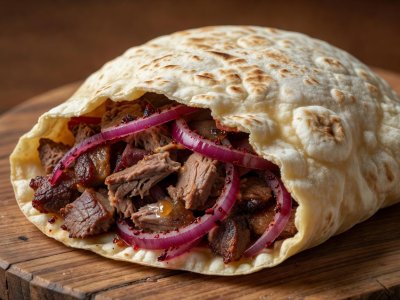
Soft-lit 3D render illustration of thin domed saj flatbread with sumac onions and roasted meat Levant & Anatolia

Saj Bread, Tantuni & Shawarma

Baked on an inverted metal dome (saj) closely resembling a northern Mexican convex comal, paper-thin markook or lavash bread wraps spiced meats, sumac-rubbed onions, and tahini or pomegranate acid.

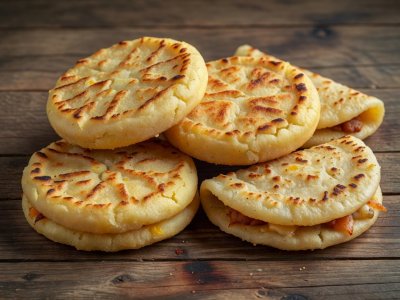
Soft-lit 3D render illustration of thick griddled maize arepas and folded salvadoran pupusas Central & South America

Pupusas, Arepas & Baleadas

Across the Americas, sister traditions celebrate maize and wheat: Salvadoran stuffed masa pupusas served with fermented cabbage curtido, Colombian and Venezuelan griddled arepas, and Honduran wheat-flour baleadas.

3D studio renders shown as conceptual illustrations, not documentary evidence of regional practice.
03 / Cross-Border & Diaspora Evolutions

How Borderlands and Migrant Kitchens Created New Traditions

When borders shift or workers migrate, street food adapts without losing its structural integrity. In late 19th-century San Antonio, Texas, Mexican-American women known as the "Chili Queens" set up night-lit open-air plazas serving chili con carne, tamales, and tortillas. In the 1970s along the Rio Grande Valley and South Texas, early-morning workers popularized warm flour tortillas wrapped around scrambled eggs, potatoes, smoked brisket, and chorizo—establishing the distinctive Texas-Mexican breakfast taco culture.

Decades later in Los Angeles, Tijuana-style birria de res (beef birria) trucks sparked an international wave of quesabirria—dipping corn tortillas into crimson birria fat, griddling them crisp with melted Oaxaca or Monterey Jack cheese, and serving a cup of hot consomé for dipping. In that same city in 2008, Chef Roy Choi’s Kogi BBQ truck paired Korean galbi short ribs and gochujang-chile salsa on double corn tortillas, demonstrating how diaspora communities in urban neighborhoods naturally converse through the medium of the taco.

Read answers to common taco-culture questions